

In August 2026, Tara Seshan, Product Lead for Codex and ChatGPT Work at OpenAI, shared a simple framework for where AI products are headed: three eras, each building on the last.
Her take mirrors how we feel about AI in real estate investing, and in this guide, we expand on it in detail, highlighting what each era covers, where many firms and providers still are, and what it takes to move to the next level.
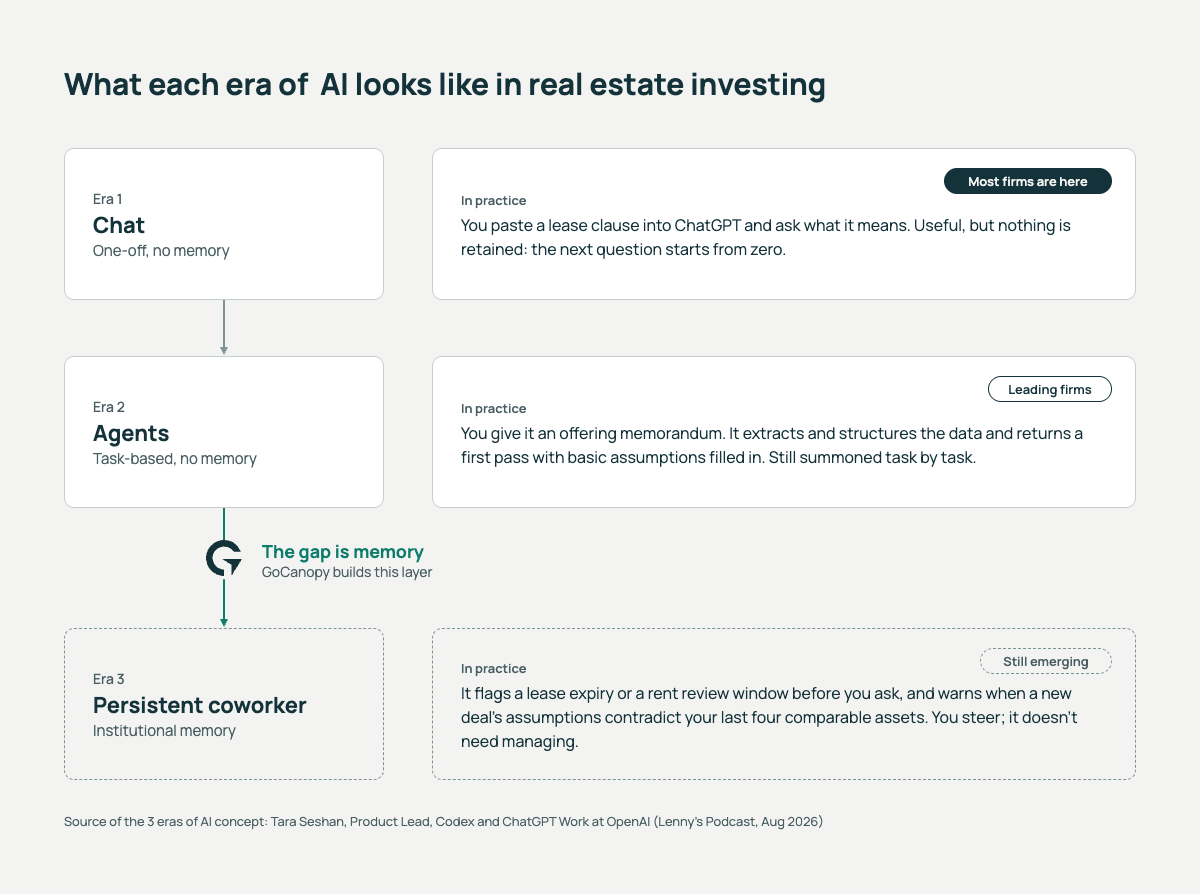
The 3 eras of AI at a glance
- Era one, chat: Type a question, get an answer. Useful, but the system doesn’t retain anything, so every query starts from zero.
- Era two, agents: Software that carries out multistep tasks with limited supervision. Still summoned per task, but the work gets delegated rather than typed out by hand.
- Era three, persistent coworker: An AI that works alongside people continuously, holding shared context over time, rather than being summoned for one task and dismissed.
Many firms, including some tools marketed as "AI for real estate," are still in the first era or barely brushing the surface of the second, let alone the third.
Where the industry actually is: eras one and two
Era one is an offering memorandum you upload into Claude to get the highlights, a lease clause you paste into ChatGPT to abstract, or a quick question you ask and get an answer to. It's useful, but that's about it.
The chatbot doesn't retain anything or analyse further, so your next similar question still starts from zero, even if your colleague is looking at the same deal in the exact same market, or it's the exact same lease you're asking about a week later.
That’s where most real estate investment teams are today. It's also, underneath the marketing, what a lot of "AI for real estate" tools actually are: one-shot extraction with a nicer interface wrapped around it. We break down which tools fall into which category, and what to actually use at each stage, in our guide to the best AI tools for real estate investors.
Era two is where the leading firms are now. Instead of asking questions, they delegate work. An offering memorandum comes in, and an AI agent ingests, structures, and files it into a permanent record. At this stage, the analyst's job shifts from retyping numbers to reviewing them.
This is the exact bottleneck we built our investment workflow around: moving comps, models, and decision materials out of manual assembly and into something a team can actually act on.
That's real progress, and it's worth noting. But you still need to summon agents in era two per task. They do the work you hand them, but don't actually know what you both worked on last month. They also can't tell or notice if a new deal's assumptions contradict what the firm found on four comparable assets last year.
This gap is exactly where most of the industry's AI ambitions currently stall.
Multiply that gap across a whole team, each analyst running their own disconnected tools their own way, and you get shadow AI: dozens of one-off workflows nobody can standardise, compare, or fully trust.
What era three actually requires
What separates era three (persistent AI coworkers) from era two (AI agents) and one (AI chatbot) isn't autonomy. An AI chat app that simply parses data is thoroughly basic and unarguably era one. Meanwhile, an agent that completes a task on its own is still era two if it forgets everything the moment the task ends.
In Seshan's framing, era three falls into two categories: persistence and shared context, and trust without a test suite. Neither of these suggest trusting AI blindly. Traceability is simply what makes checking its work fast, because every number links back to where it came from. The review step stays; it just now takes seconds instead of hours.
Persistence and shared context
Era three describes an AI that remembers what it worked on yesterday and builds on that memory today, collaboratively, over an extended period. At GoCanopy, we simply call it institutional memory.
The analogy to remember when differentiating autonomy from memory: rowing versus steering. In era two (rowing), a person still directs each task an agent completes. In era three (steering), the person sets direction while the coworker carries it forward on its own initiative, informed by everything it already knows about the work.
Now to the memory layer. Picture two analysts looking at the same deal. One is a bright graduate, just out of university: sharp, fast, and perfectly capable of reading an offering memorandum cover to cover. The other is a veteran investor who has seen thousands of deals.
The veteran can often scan the same deal in a few minutes and know whether it has legs and is worth the team's time, because they've seen this kind of tenant, market, or rent assumption before. The difference isn't merely intelligence. It's accumulated knowledge, and it compounds with every deal.
Today's AI agents are the graduate: brilliant, but starting fresh on every task. An era-three coworker is the graduate with the veteran's memory.
There's also a firm-level problem. In most firms, that veteran's experience lives in one person's head. When they leave, it leaves with them, and the firm starts again with the next graduate. Institutional memory is what turns one person's experience into the firm's.
Trust without a test suite
This requirement matters even more for a field like real estate, and the difference between coding and knowledge work is a great way to think about it.
You can verify code by pressure-testing it in sandbox environments. But knowledge work has no such check, so the only way to trust an AI's output in a domain like real estate is process transparency: being able to see exactly how the AI derived a number or conclusion.
If you skip this verification step and something goes wrong with a deal, you don't just stand to lose a few dollars; you could lose hundreds, thousands, or millions.
Yet real estate doesn't have any of these (persistence, shared context, or trust without a test suite) fully figured out yet. Many firms don't have a persistent, shared memory of their own deal history. And most of the tools built for them are clouded in black-box AI (i.e., they don't show their work or prioritise traceability).
The part most real estate AI adoption roadmaps need to fix
Compounding institutional memory is a precondition for era three, not a part of era three. Here’s why.
A persistent coworker on an investment team is only possible if the firm has a searchable, shared memory of its deals, tenants, and assets to draw from. Without that memory, an AI coworker has nothing to perpetuate. It would just be a very polite agent, re-introducing itself every morning.
Which means nobody arrives at era three by buying a "better" agent. They arrive there by building the memory layer first, while they're still technically operating in era two.
The firms treating memory as a nice-to-have, something to bolt on once the agent tooling is further along, have the sequence backward. Memory isn't the layer you add after the agent works. It's the layer that makes a persistent agent possible at all.
The same logic applies to governance. Firms often try to finish a full AI governance framework before anyone touches a tool, when the better sequence is the same one that gets you to era three: light guardrails now, a framework that matures alongside real usage.
We go deeper on what that lighter-guardrails approach looks like, alongside three other adoption strategies, in how real estate firms are actually approaching AI adoption.
What era three looks like in practice: An era-three system doesn't wait for your queries. It notices and flags an approaching lease expiry, sees and surfaces a rent review window opening, and catches a contradictory assumption in a new deal without prompting.
Building the memory layer now
Much of what's marketed as AI for real estate investment is era-one tooling with an era-two or era-three pitch. Better extraction, faster summaries, a cleaner interface, but with the same one-shot workflow underneath. They're still useful, but they don't retain or compound institutional intelligence.
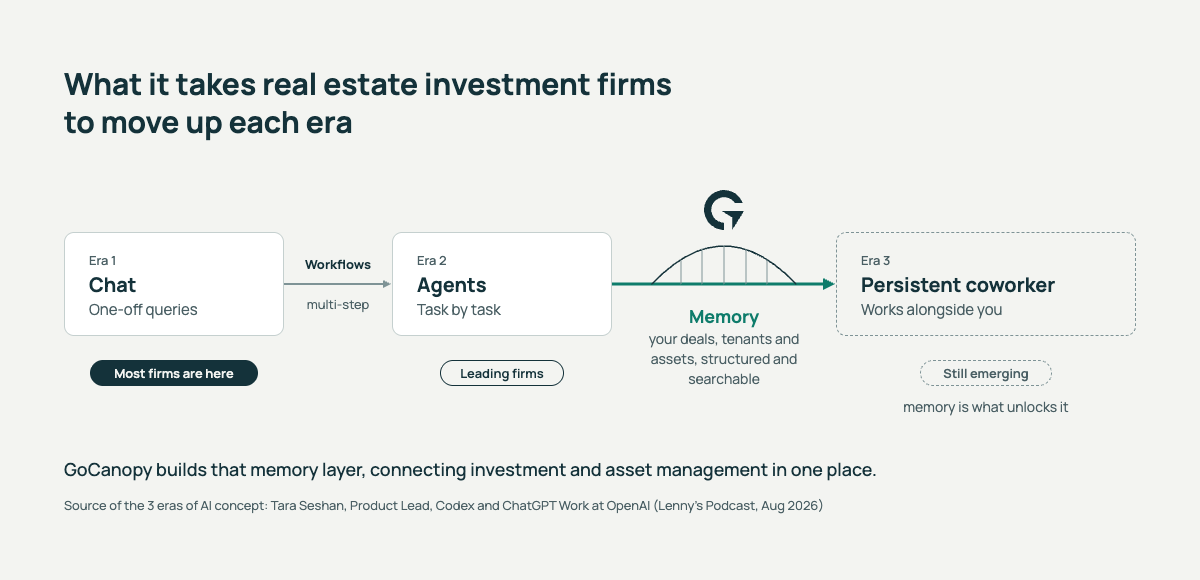
Here's where GoCanopy comes in. Instead, we've built the memory layer itself: every document, assumption, or deal a firm's ever worked on, structured and retained as a permanent, searchable record, with every extracted figure traceable back to its source page.
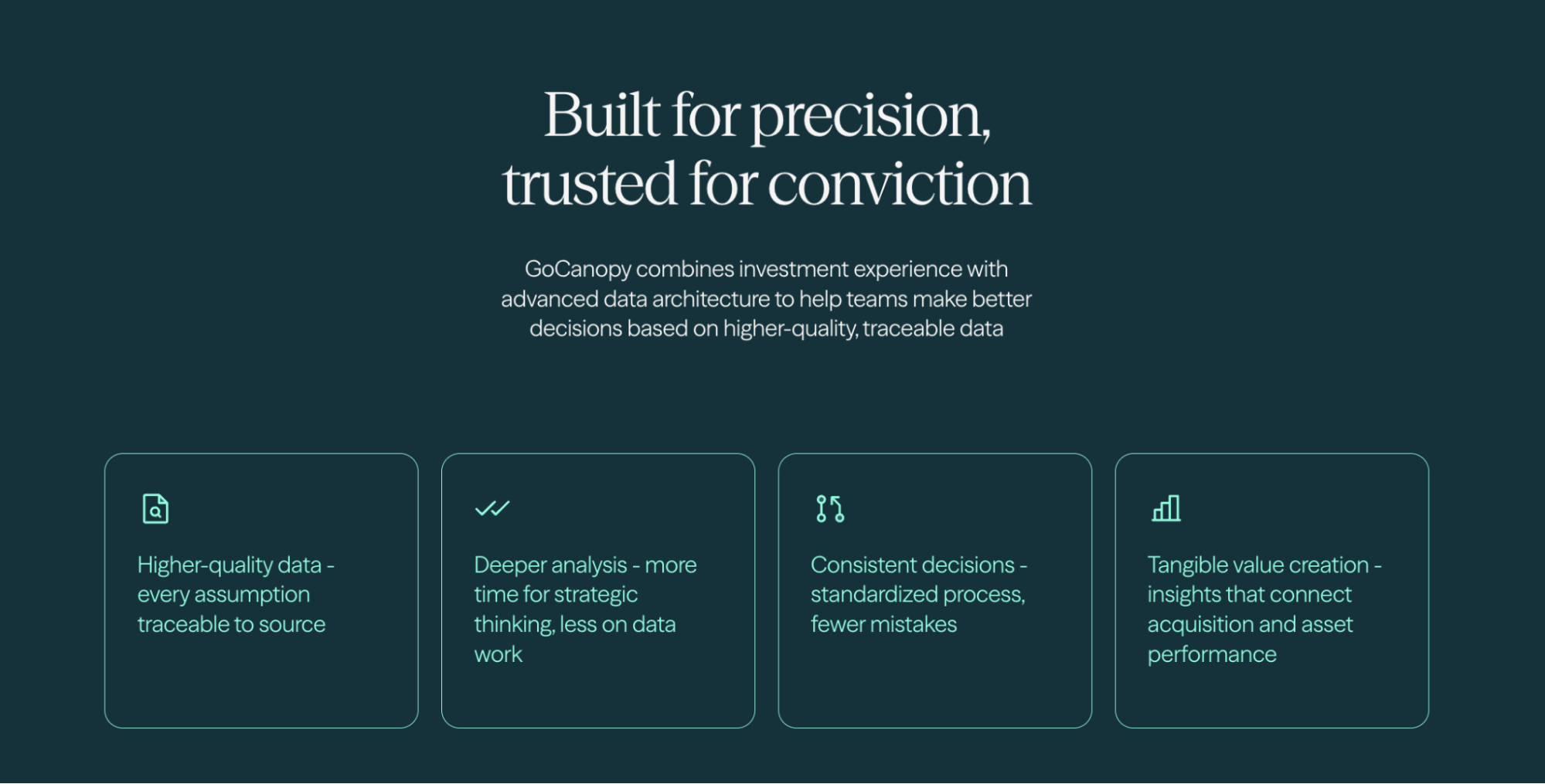
That traceability isn't a feature bolted onto the memory. It's the same process-transparency requirement Seshan describes for knowledge work generally, applied to real estate specifically, because an IC memo is only defensible if you can trace every number in it to a source document.
GOCANOPY CUSTOMER STORY
“GoCanopy delivers instant, consultant-grade analysis with verifiable sources that hold up under IC scrutiny. We are fully leveraging all the data we receive and generate, and extracting all the insights. We now experience effective cross-pollination of information across investment and asset management teams.”
Ben Segelman, European Head of Logistics and Data Centre Real Estate at Brookfield
Memory first, coworker second
The sequencing matters more than the timeline.
Firms that skip building a real memory layer now, while the industry is still largely in era one and two, won't move into era three by waiting for a better or more sophisticated agent to come along. They'll be renting era-two tools indefinitely, each one starting from zero, none of them compounding institutional portfolio intelligence over time.
Getting to era three requires moving completely past era one and spending era two building the memory layer any future coworker (human, AI, internal, or external) would need to work efficiently, regardless of employee churn and fund volatility.
That's the problem we set out to build for, coming from the investing side ourselves (more on the team behind GoCanopy here).
If you'd like to see how our AI-native real estate investment management platform fits into your firm's existing workflows, book a free live demo today.
FAQs on the 3 eras of AI in real estate investing
Shadow AI happens when individual analysts and teams use AI tools on their own, without a shared standard, creating dozens of one-off workflows that never compound into anything the firm can reuse.
Everyone ends up reinventing the same prompts and the same mistakes, and nobody can say which version of the analysis is actually reliable. It's the natural result of staying in era one and two without ever building a shared memory layer underneath.
An AI governance framework is the set of guardrails a firm puts around how it uses AI: who can use which tools, on what data, and how outputs are checked before they inform a decision.
You don't need to have one fully defined before you start. Firms get stuck because they try to finish the framework before anyone touches a tool. The better sequence is to set light guardrails early, then let the framework mature alongside real usage.
Black box AI refers to any system whose outputs you can't trace back to how they were actually derived. You get a number or a conclusion, but not the reasoning or the source behind it. In most industries, that's an inconvenience.
In institutional real estate, where a single mispriced assumption can cost hundreds of thousands of dollars, it's a liability because a number nobody can defend in an IC meeting isn't useful, no matter how accurate it is.
Most AI adoption stalls for the same reason: it never moves past one-off, disconnected usage. A tool that helps one analyst move faster on one task doesn't compound into anything the firm can rely on for the next deal.
Without a shared memory layer connecting that usage over time, every gain resets to zero, which is why so many firms report piloting AI widely without seeing the returns they expected.
Traceability. Any figure an IC will act on needs a clear line back to the source document it came from, the specific page, the specific clause, not just an AI's summary of it. Without that trace, a number is only as trustworthy as the person willing to vouch for it, and in a room full of people whose job is to find flaws in your model, that's not a strong position to defend. GoCanopy can help.