

Ten years ago, institutional investment teams largely relied on Excel models and enterprise platforms to support their investment workflows. Today, AI has become the layer that augments that technology stack.
Across industries and geographies, almost 90% of organizations are piloting AI programs, yet only 5% have realized the outcomes they expected. Commercial real estate is no exception, presenting a window for fast movers to gain a competitive advantage now while others play catch-up later.
If you're evaluating AI for commercial real estate for the first time or trying to move beyond isolated experiments (yes, we're looking at everyone whose AI strategy starts and ends with Claude), this guide will help. It's also valuable for investment teams looking to integrate AI with existing tools like Excel, Argus, or Yardi.
Read on for four practical strategies to support thoughtful AI adoption, scale what works, and strengthen investment decision-making.
1. Build a dedicated AI committee from across the organization
More than just another technology initiative, AI adoption across investment workflows and real estate operations presents a change management challenge. Investment teams experiment with one tool, asset managers use another, and nobody can really track usage or productivity improvements across departments.
To design your AI program around real business goals and get everyone on the same page, establish a cross-functional implementation committee. Pull stakeholders from investment, asset management, operations, IT, and compliance. Their role is to define team-specific objectives, identify individual team members’ AI workflows worth scaling, and surface potential risks.
The committee’s work also naturally uncovers emerging generative AI usage, so they can formalize successful systems and rein in shadow AI before it becomes a governance issue.
Once your governance is in place, the next question becomes: Which tools will actually help your team get from where it is today to where it needs to be?
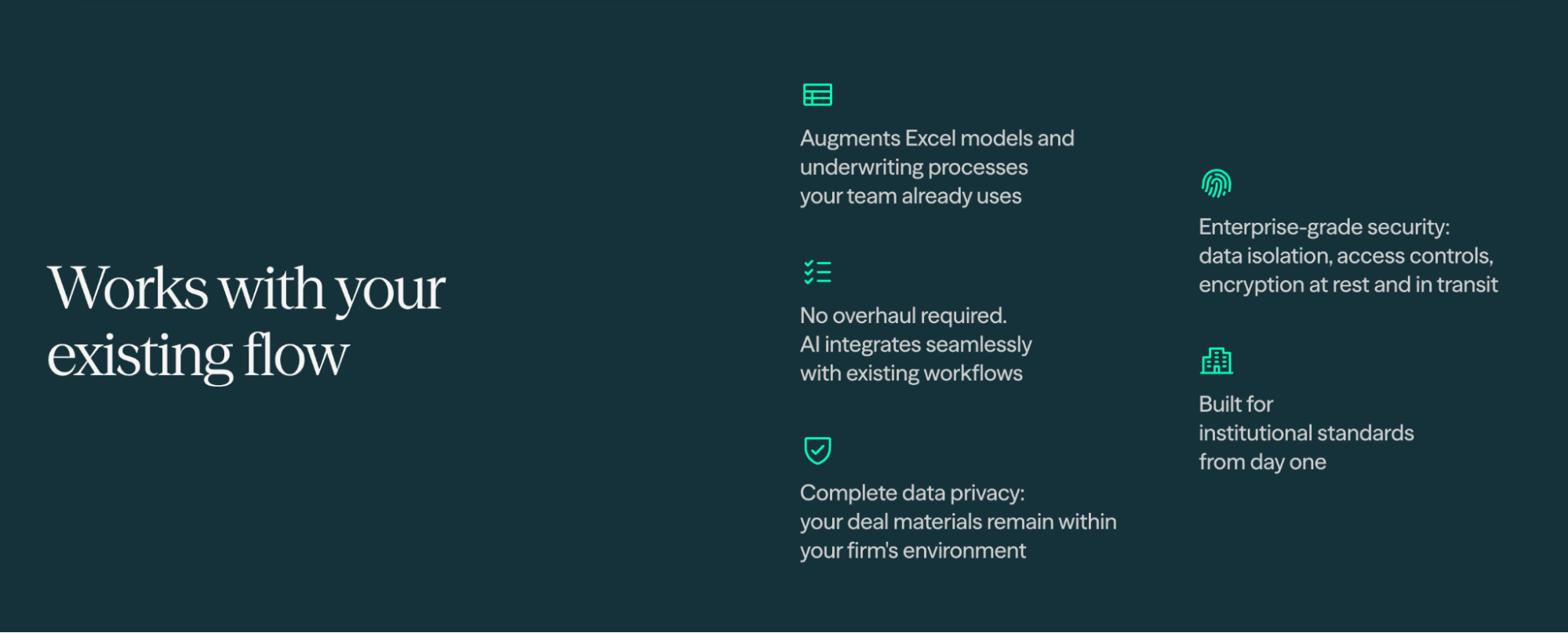
2. Prioritize software with low-friction onboarding to boost adoption
The most effective AI platforms aren’t the ones with the longest feature list; they’re those your team actually adopts. Software that goes live in days or weeks will almost always outperform months-long implementations that steal already-limited hours from busy, highly paid commercial real estate professionals.
If implementation requires time-consuming file uploads, extensive retraining, workflow disruption, multiple consultants, or unpredictable usage costs, adoption will likely stall before value materializes.
Security deserves equal scrutiny. Before approving and rolling out any AI solution, confirm how it handles sensitive investment and proprietary data. Is customer data used to train foundation models? What certifications does it hold? And does it meet your firm's governance requirements?
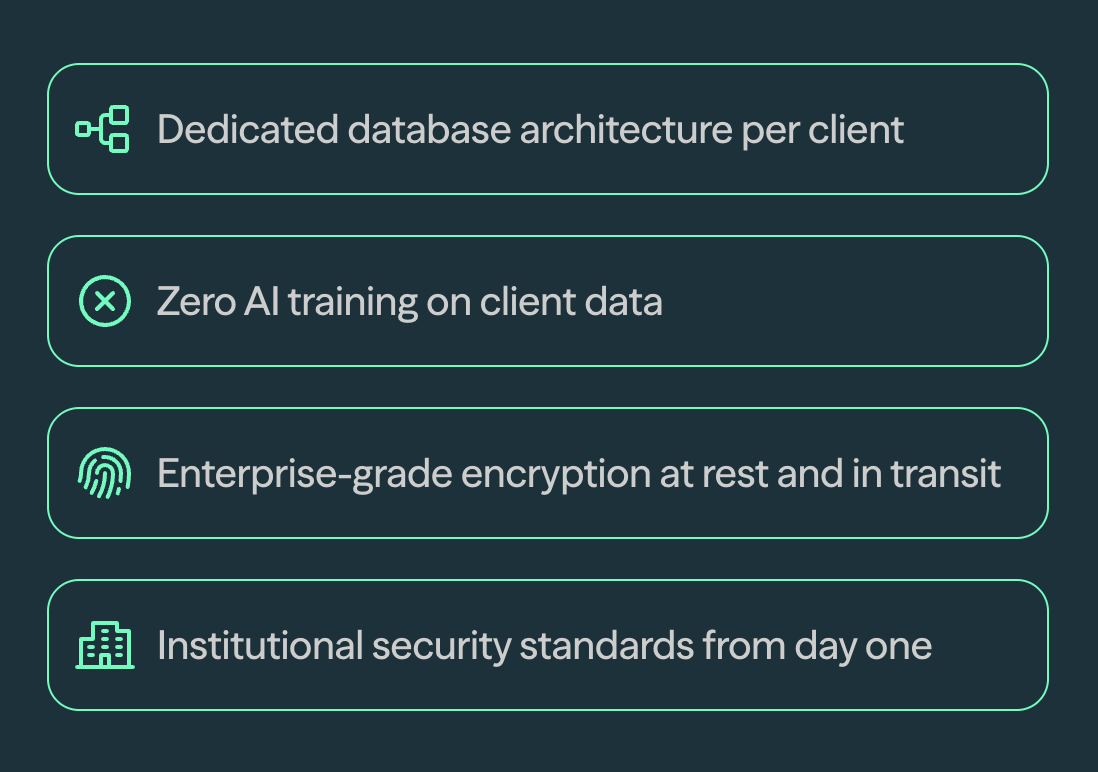
You’re trying to make things easier, not harder. The last thing you need is a tool that creates more work or introduces legal risks while struggling to deliver the promised transformation.
While some teams also choose to build custom AI agents, copilots, and capabilities in-house, we don’t recommend it unless doing so is itself a competitive advantage for your firm. Purpose-built AI applications often offer faster time-to-value while reducing maintenance, governance, and security overhead.
3. Use AI to eliminate deal groundwork (not replace human expertise or overturn existing workflows)
“Artificial intelligence shouldn’t replace human judgment” has become a tech conversation cliché at this point, but it exists for a reason. When push comes to shove, humans take the fall or glory, machines or no machines.
The ideal AI implementation balance in the commercial real estate sector looks like this: Teams collaborate with AI to uncover sales comps and prep materials while retaining full control and elevating decision quality.
| AI should | Humans should |
|---|---|
| Extract lease terms and identify opportunities | Evaluate deals |
| Summarise due diligence documents | Build and strengthen conviction |
| Compare deal materials and surface inconsistencies | Make defensible recommendations |
| Draft investment committee memos | Approve, reject, or exit deals |
Bottom line: Let AI augment the work your team already does, especially recurring groundwork like summarizing data from PDFs, spreadsheets, emails, and other disconnected sources, while maintaining full traceability. Stay in control while reducing manual friction across the entire investment workflow.
4. Centralize deal flow intelligence to compound firm-wide knowledge
Reliable data is critical for effective AI use in the commercial real estate industry, and every acquisition, underwriting exercise, and investment committee meeting contributes to creating this knowledge. The problem is that it often remains trapped in personal spreadsheets, notes, inboxes, and AI prompts. A tailored intelligence platform centralizes fragmented historical data, so insights compound over time rather than disappear when team members move on.
This way, every analyst (new or experienced) can get access to the context and data sources behind previous decisions. Why did the firm pass on a deal? Which assumptions proved wrong? Which underwriting patterns consistently led to strong outcomes? When that knowledge becomes searchable rather than scattered across multiple locations, every future investment benefits.
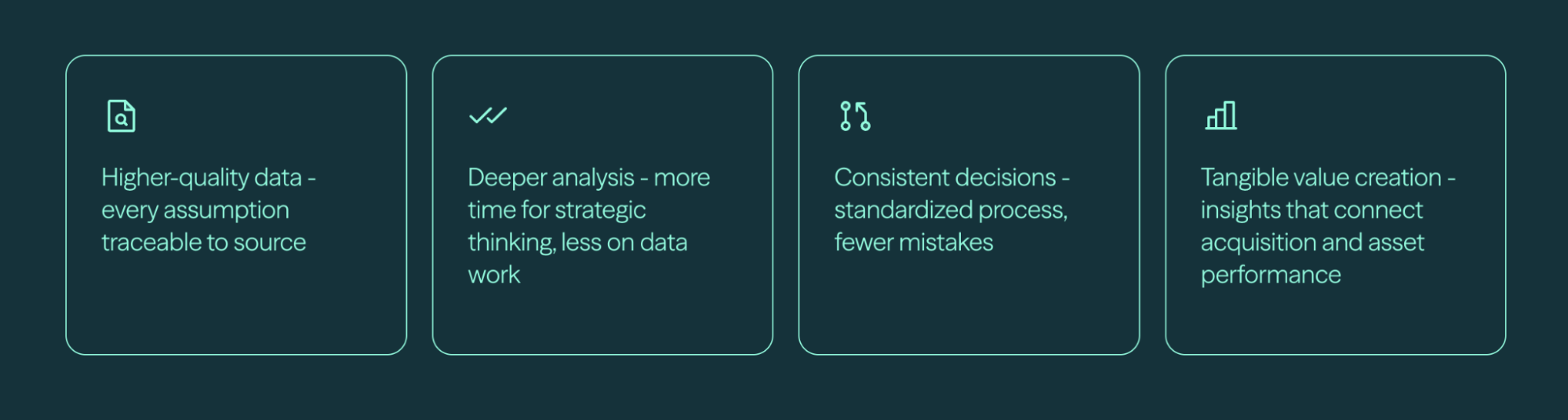
Here’s where source traceability comes in. To satisfy compliance requirements and withstand investment committee scrutiny, every AI-surfaced insight should remain transparent, editable, and linked back to its original source.
An auditable investment workflow reduces verification overhead because stakeholders can see exactly where each insight originated. This visibility in turn builds confidence, improves consistency, and makes recommendations easier to defend during IC reviews.
Use GoCanopy, the AI-native platform for more consistent CRE investment decisions
Perfect data is a mirage. Focus instead on unifying the available information and making better decisions with it.
Enter GoCanopy, a purpose-built AI-native platform that quickly ingests, organizes, and analyses unstructured data, reducing repetitive manual work and strengthening strategic decision-making across the investment lifecycle.
From underwriting and due diligence to investment committee preparation, acquisitions, and portfolio performance management, GoCanopy helps institutional real estate investors automate tasks, preserve institutional knowledge, and make better investment decisions with confidence.
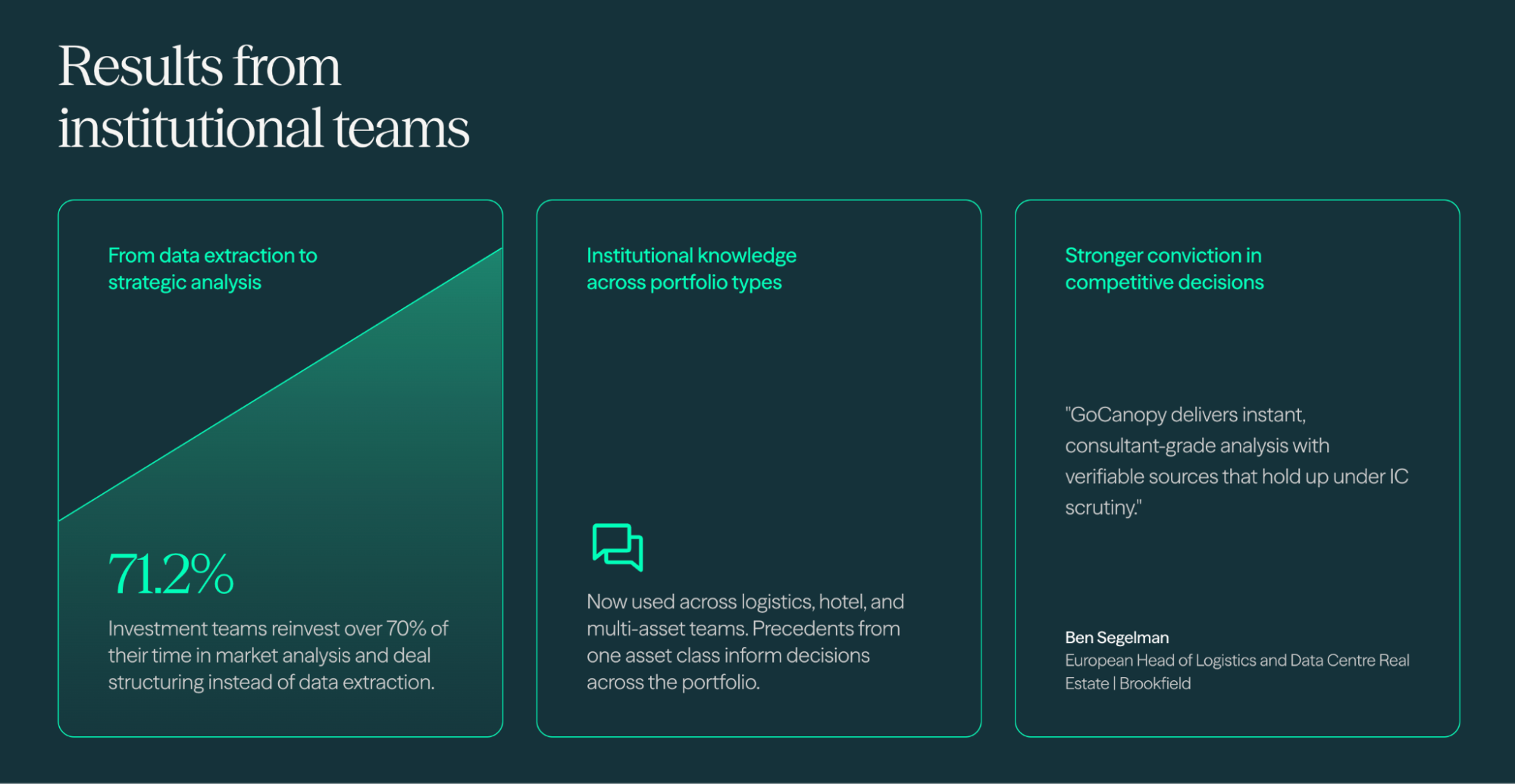
Want to see exactly how the platform embeds AI functions into everyday CRE investment workflows without compromising governance, transparency, or human judgment? Book a free live demo today.
FAQs
Institutional real estate investors use artificial intelligence to automate repetitive tasks that slow down investment teams. Instead of manually extracting lease clauses, rent rolls, financials, investment memoranda, and broker emails, commercial real estate AI tools can structure that information, surface actionable insights, and prepare investment committee materials in a fraction of the time.
For example, AI systems help with document processing, writing assistance, investor relations, market data analysis, predicting future property performance, managing portfolio assets, and flagging risks in legal documents. The goal is to free up teams to analyze opportunities, screen more deals, and make higher-conviction decisions.
It depends on where your competitive advantage lies. If your CRE firm has the resources to build and maintain AI infrastructure, developing internal tools may make sense. However, a purpose-built platform can deliver value much faster while reducing the ongoing burden of maintenance, governance, model updates, and security. Ultimately, the automated systems that benefit CRE professionals the most are those they actually adopt and use consistently.
Shadow AI refers to employees using AI tools and machine learning models outside the company's approved systems and protocols. It often starts with good intentions. An analyst uploads a memo into a public AI tool, an acquisition team creates its own prompt library, or different departments adopt separate copilots without a shared real estate investment strategy.
Left unchecked, this isolated usage creates security risks, inconsistent outputs, and disconnected workflows. Coordinated AI committees and programs help standardize what works while keeping sensitive investment data secure.
The biggest barriers to AI adoption in commercial real estate are rarely the technology itself. More often, firms struggle with fragmented data, legacy systems, governance and security risks, high implementation costs associated with credit-based AI models, unclear ownership, concerns about output accuracy, and low user adoption.
Start with a cross-functional implementation team, prioritize AI tools that integrate with existing workflows, and focus on high-impact, repetitive tasks first. This approach helps demonstrate value early, control costs, and scale sustainable AI use over time.
GoCanopy brings your deal flow, documents, and investment data together in one place for operational efficiency. Instead of switching between inboxes, spreadsheets, shared drives, and PDFs, teams can capture, structure, search, and compare deal information from a single platform.
From acquisitions and due diligence to investment committee preparation and portfolio reporting, GoCanopy helps institutional investment teams move faster, make fewer mistakes, and gain greater confidence.