

Like with every other industry, digital tools have disrupted the real estate space, but so has the confusion about which to choose. Every real estate technology platform promises automation, structure, and visibility, yet only a few actually deliver all of these in the long term.
Some teams and investors start with traditional proptechs, which seem like a fit at first. But ultimately, they struggle to fully adopt these tools due to largely manual onboarding processes that involve spending hours entering data before seeing any real ROI.
Today, AI tools address this exact challenge, but it’s not always clear which one fits your needs. If that sounds familiar and you’re wondering where to start your real estate AI journey or how to get more results from LLM-powered automation, keep reading.
Here, we’ll break down the 11 best AI tools for real estate investors by adoption readiness level and user type, showing how to move from streamlining daily processes with AI to building accessible internal memory.
How is AI being used in real estate?
Real estate professionals spend many of their days reading, extracting, comparing, and drafting. AI systems are shifting this workload by acting as a reasoning model for these daily tasks.
These tools help real estate professionals and property investment firms structure documents, uncover insights that manual analysis misses, and retain expertise that would otherwise disappear when key team members leave.
While some focus on automating routine tasks and boosting labor cost savings, others prioritize building institutional intelligence.
| Lifecycle of AI in real estate | ||
|---|---|---|
| Streamlining daily processes | → | Generative AI apps |
| Designing tailored workflows | → | Custom AI solutions |
| Building institutional memory | → | AI-native platforms |
Broadly, AI in real estate falls into three categories:
- Generative AI apps: Focused on simplifying simple tasks. They help real estate professionals and investors execute workflows such as creating marketing content, underwriting potential acquisitions, drafting digestible investment memos, or simply generating social media posts. These tools can serve as a starting point for property experts and teams new to using AI, helping them test the waters.
- Custom AI solutions: Skills, agents, and tools built to help realtors and investment or asset management teams complete tasks even more quickly, since they don’t need to start from scratch each time. They often automate activities such as generating listing descriptions or drafting quarterly Limited Partner updates from property manager reports—but they don’t maintain a comprehensive knowledge base.
- AI-native platforms: Designed for real estate experts or companies that want control and scalability. Instead of treating AI as an isolated feature, these platforms serve as core reasoning engines for professionals and teams.
They offer clean data ingestion and structuring, AI-augmented workflows, and compounded intelligence across the property lifecycle, empowering users to build deeper internal memory and identify hidden opportunities.
How to choose the right tool
Now that you understand the main types of AI tools in the real estate industry, the next step is figuring out which fits your current stage and needs. Each platform has its tradeoffs that can affect long-term success, and these are a few factors to consider:
- Control: How much ownership and visibility do you have on the platform?
- Possible gains: What ROI does the system support—e.g., improved deal velocity or fewer missed opportunities?
- Scalability: Can the tool scale as your asset portfolio and/or your team grow, or will you outgrow it?
- Cost: How does the platform’s total cost of ownership or usage align with your budget and projected ROI?
Control and security
Ask yourself: Do you have a trusted data storage location, or is it exposed to potential privacy issues? On generative AI apps, your information may be used to train AI models and possibly influence outputs provided to competitors who also use them. If policies change or accounts are restricted, your information could also disappear overnight.
Platforms that guarantee airtight security let you create an AI-optimized, searchable knowledge base, ensuring reliable institutional memory.
Possible gains
Look for tools that support multiple revenue-related goals, such as:
- Unifying fragmented data scattered across PDFs, emails, and disconnected platforms to remove the need for manual data collation.
- Generating data-backed, traceable deal and property value insights, from first pass to final presentation.
- Revealing hidden opportunities through acquisition projections properly connected to actual portfolio performance
- Freeing up realtor or analyst time so they can reinvest it in advanced data analysis and property research.
Relying only on basic real estate artificial intelligence automation can limit your range of capabilities. But a custom-built tool lets you coordinate and structure several high-volume investment tasks (e.g., lead generation and property management), ensuring more visibility and long-term value.
Scalability and AI integrations
As your asset portfolio or institutional data grows, your system should scale with you. The right platform lets you incorporate new automation use cases and drive AI adoption without creating more fragmented modules, switching at new growth stages, or adding other costlier tools to your stack.
Cost and ROI
Pay attention to pricing models and fees. Some platforms have credit limits, while others charge flat monthly rates or provide custom quotes. A small cost difference may not matter at first, but it can significantly increase your expenses as dependence grows, sometimes overshadowing the value you get from the system.
Best tools (by AI adoption readiness stage)
| AI adoption readiness stage | Newbie (Stage A) | Intermediate (Stage B) | Pro (Stage C) |
|---|---|---|---|
| Example | ChatGPT | Microsoft CoPilot | GoCanopy |
| Pro | Quick and easy to use | Adds some structure and visibility | Builds internal memory and surfaces opportunities others miss |
| Con | Limited utility and security | Time and resource-intensive | Mild learning curve, but worth the ROI |
Stage A: New to AI, testing the waters
Before you can gain structure and visibility, your goal may be finding out some of the daily to-dos that AI technology can automate. Generative AI tools help you speed up the completion of repetitive tasks like acquisition underwriting or report summaries.
These platforms save time here and there, but they come with trade-offs. You get unprecedented speed, but little control and security. Usage limits and credit systems decide how much content you can generate or analyze, and depending on the plan and settings, your inputs may be used to train the underlying models.
Here are the top generative AI apps you can use when exploring LLM-powered automation for your real estate needs:
ChatGPT
If your focus is on comprehensively analyzing data and sourcing deals, ChatGPT can serve as a rapid information parser, even for complex, unformatted files. Once you import the relevant documents (e.g., rent rolls and leases) to the platform, it can quickly screen deals, draft investment memos, and deduce risks.
But ChatGPT’s utility is volatile. Its outputs depend heavily on how clear your prompts are and the quality of documents you upload to it, so the platform is more prone to errors or hallucinations if unverified.
Realtors and investors who use ChatGPT must strictly treat it as an early-stage screening tool for identifying macro market trends and abstracting documents, then guide the verified data into dedicated real estate AI platforms.
Perplexity
Perplexity functions as a real-time web search engine, offering one of the most reliable paths to property market research. Its blend of live web scraping and instant source citation lets you surface relevant real estate data long after traditional reports are published, from neighborhood demographic changes to local zoning updates.
You can successfully assess real estate market conditions on Perplexity by enhancing your property search prompts with hyper-local keywords, e.g., street names or city council meeting dates, to uncover hard-to-find public PDF files.
Overall, Perplexity can significantly reduce the time you spend on residential and commercial real estate research. It also helps identify investment opportunities ahead of competitors.
Still, the best move is to quickly gather the facts with Perplexity, then gradually guide this raw data into an owned system that offers more control, unified storage, and data protection. Especially if you handle institutional real estate investments, as these require more structure than individual property investors.
Claude (Chat only)
Similar to ChatGPT and Perplexity, Claude Chat works okay for parsing deal data and conducting property market research. It saves time and frees analysts up to focus on finalizing investment decisions and managing existing assets.
However, Claude isn’t built to accurately retrieve and query data the way dedicated AI real estate tools are, especially in its simplest form as a chat answer engine. Beyond its free limited plan, Claude’s token-based subscription model also racks up costs very quickly, pushing budget limits and delivering average ROI.
Stage B: Looking for more tailored AI solutions
Once you’ve wrapped your mind more around the idea of using AI to streamline day-to-day real estate workflows, the next step is adding some structure. You can do this either by mastering these platforms and creating custom AI solutions yourself or by working with implementation partners such as Next Automation or Xcelacore.
These tools make it easy to create bare-bones systems for your real estate AI applications, e.g., an AI agent or virtual assistant that monitors local property listings daily and fast-tracks lease abstraction. They also integrate well with existing company systems.
So they’re great for testing what it would be like to truly leverage the power of LLMs for data organization and visibility, before investing in a more scalable platform. Especially because they don’t fully deliver the retrieval accuracy institutional decisions demand.
Microsoft Copilot
Microsoft Copilot is a fair option for real estate agents and institutional investment firms—constantly buried in underwriting models, lease portfolios, and more—looking to structure their workflows using low-code AI agents.
For example, you can build tailored Copilot agents in Microsoft Copilot Studio to handle recurring tasks such as legal document analysis, pipeline screening, and monitoring market dynamics. You can then save the agents directly into in-app project folders, allowing you (and your team members) to easily reuse or apply the same logic across multiple properties and deals.
The main limitation here is that configuring and refining these AI real estate agents requires a steep upfront investment of time and resources. Yet, the end results remain average and siloed, stopping just short of delivering a fully unified cross-portfolio internal memory.
Claude Code
Claude Code works similarly to Copilot at this stage, except that it’s an actual coding assistant for software developers, not a low-code builder. It also stands out with its “skills” feature (reusable, filesystem-based resources that provide Claude with domain-specific expertise).
Claude Skills are built on deep workflow rules, industry-specific context, and defined best practices, transforming a generic AI tool into a specialized real estate expert. So unlike prompts that are chat-level instructions for one-off tasks, these skills load on demand, eliminating the need to rewrite or copy-paste lengthy guidance across multiple conversations.
You can use Claude Skills to automate specific processes, such as parsing Offering/Information Memorandums (OMs or IMs respectively) or analyzing zoning laws. E.g., a lead-qualifier skill can help acquisitions teams and asset managers automatically screen incoming broker deals and rank properties by investment-thesis match.
With the app’s API and coding capabilities, your developers can also layer Claude onto existing real estate data streams to function as a highly responsive Automated Valuation Model (AVM) engine. However, like Copilot, Claude doesn’t maintain structured historical data for real estate investment firms or individual landlords. So running one-off queries on Claude can work in the interim, but it’s ultimately unsustainable long-term.
Stage C: Ready to go all in with AI and compound ROI
Once you’re fully sold on incorporating AI into your real estate operations, it’s time to build a system that can scale sustainably. This stage can apply when you want to skip the hassle of generic AI apps and custom AI solutions altogether, or if you have explored them and gotten to either of these crossroads:
- The strain of juggling and integrating multiple tools has started slowing you down; or
- Stacking too many autonomous AI agents and workflow solutions across projects has made it incredibly difficult to pinpoint what’s working or broken.
At this point, it makes sense to move to either an AI-native tool for small landlords and independent portfolios or an intelligence platform custom-built for institutional real estate firms.
GoCanopy
GoCanopy combines data management, AI-powered workflows, and historical investment intelligence into a single system, giving institutional investors holistic firm-wide memory across deals.
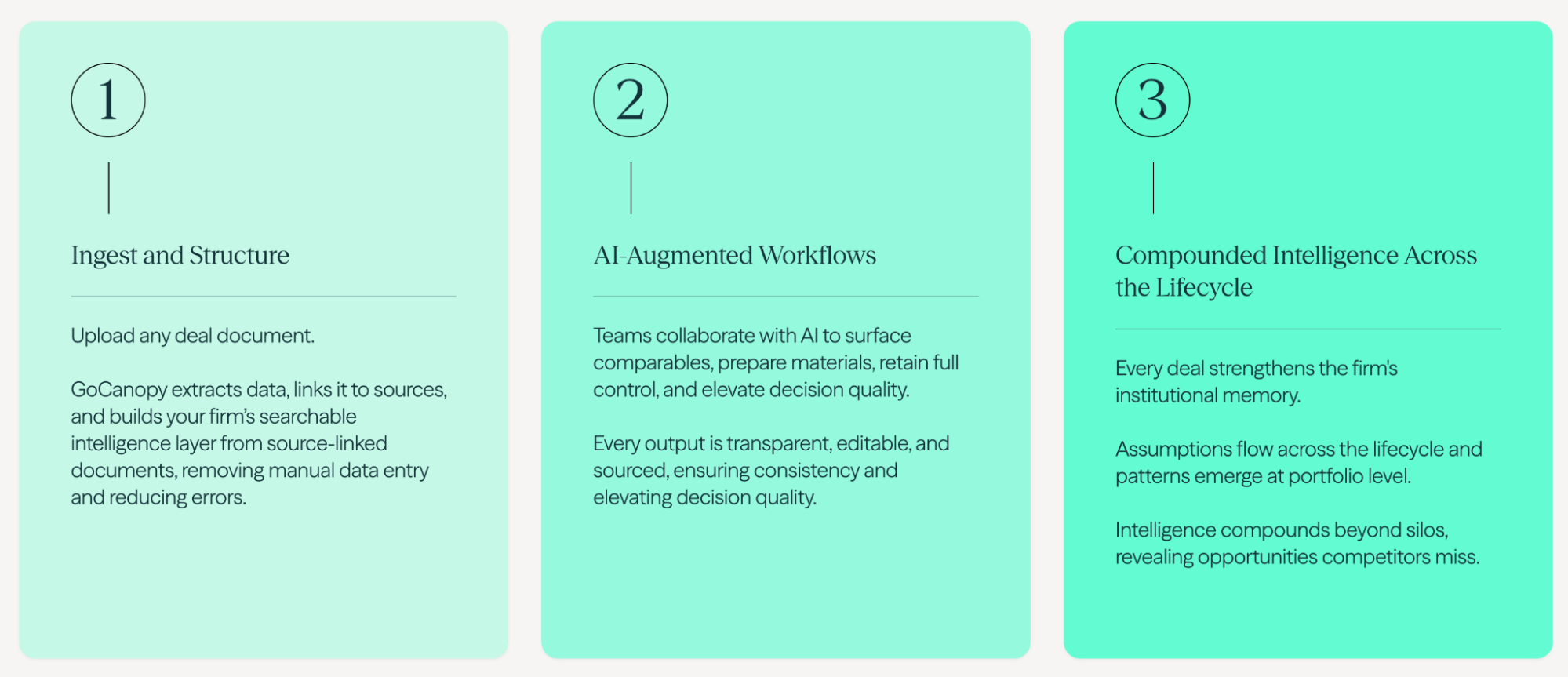
With GoCanopy, real estate analysts and managers can read and extract data across their entire pipeline from a single platform. It also lets users compare deals and draft new docs based on the information they already have internally. GoCanopy:
- Organizes fragmented data from deal files, broker packages, PDFs, valuation models and internal spreadsheets into one searchable business intelligence layer.
- Automates underwriting and diligence preparation using agentic AI workflows that significantly reduce manual data entry and human oversight.
- Surfaces comparables and historical data from past deal flow to quickly evaluate incoming opportunities.
- Generates defensible investment committee materials and memos where every extracted assumption and metric is directly linked to primary source documents.
- Tracks portfolio-level AI-driven analytics and tenant risks from a single unified workspace that spans from screening through asset management.
It’s everything institutional real estate investors need for strategic decision-making, improved deal velocity, and reduced operational grunt work, in one central platform.
The biggest upsides? Firms get to curate private, grounded retrieval systems that safely retain their institutional memory.
These teams don’t rely on public AI models that use users’ private data for training, nor do they chase overhyped predictive models. Especially because grounded retrieval beats black-box prediction in a market like real estate where data is sparse and every deal is idiosyncratic.
Rather, they gain a competitive advantage by mastering their own data layer. GoCanopy provides a secure, searchable system where investors decide how to apply institutional insights, what deals to fund, and how to move forward on their own terms.
This setup helps investors go from basic, one-off AI task automation to a long-term infrastructure layer. Instead of spending hours on manual property data extraction or using disconnected tools, they can centralize everything in a single secure platform.
By unifying operational knowledge in a single system, GoCanopy’s AI capabilities scale as data compounds, transforming day-to-day work into a long-term strategic asset.
Best tools (by user type)
We’ve ranked the top AI tools for real estate professionals by their readiness level. Now, we’ll focus on the best options by user type, because what works for institutional investors might not be ideal for independent landlords, and vice versa.
Below, we highlight the top AI platforms for each category and the exact benefits they offer.
| User type | Investor relations, fundraising, and operations teams | Property managers, investors, and landlords | Institutional investors and asset managers |
|---|---|---|---|
| Example | DealCloud | Yardi | GoCanopy |
| Pro | Centralizes investor relationships, fundraising activities, and deal data on a single platform. | Combines property management, rent collection, accounting, leasing, and maintenance. | Uses AI to centralize scattered docs into a shared database that users can easily search or review. |
| Con | Can require significant setup and customization to fit existing workflows. | Can be complex for smaller landlords with lean portfolios and basic needs. | Requires a short data-ingestion step (no manual entry) |
Investor relations, fundraising, and operations teams
If you’re an investment or operations team looking to better manage fundraising and investor relationships, or keep deal data well-organized, these platforms can help.
- DealCloud: Ideal for investment teams that want to centralize deal, investor, and fundraising data. They can help manage deal pipelines, track relationships, and build reports without relying on disconnected spreadsheets.
- Affinity: A relationship intelligence platform that lets PE, PC, and VC firms streamline deal flow and investor relationships. It automatically captures interactions, surfaces warm introduction paths, and supports firm-wide monitoring of deal activity.
Property managers, investors, and landlords
If you manage rental properties or a growing portfolio, these enable day-to-day property management, tenant engagement, and improved decision-making.
- Yardi: Best for property managers and landlords who want enterprise software that’ll manage their properties on a single connected platform. It aids smooth rent collection, maintenance requests, tenant communications, leasing, and property financials.
- MRI Software: Like Dealcloud, it's ideal for property and portfolio managers looking for deeper financial insights. Its features include an accounting tool, automated reminders, and portals for both tenants and owners.
Institutional investors and asset managers
For investment teams whose decision-making thrives on connected intelligence, GoCanopy stands out as the best AI-native real estate platform for organizing, analyzing, and scaling your first-party data. GoCanopy gives you complete ownership of your internal knowledge and deal history while fostering transparent, defensible analysis that keeps asset management teams moving faster with absolute certainty.
The right real estate AI tool changes everything
Real estate professionals need AI tools at different stages. If you’re new to applying AI, it’s okay to start with generative AI tools and custom solutions. But once you’re sure of the immense value machine learning models can bring to your real estate business, it’s only logical to move to a place where you have more control and security.
Because the true value of an AI real estate tool is seen in how accurately it can organize, query, and retrieve data.
This is where GoCanopy shines. GoCanopy is a perfect platform for enhancing institutional real estate operations by bringing unified data, AI workflows, and investment intelligence together in one place.
👉If this sounds like what you need, book a demo to see how GoCanopy can serve as your firm's core AI reasoning engine, easing daily workflows and protecting institutional memory.
FAQs on AI in real estate
Implementing an AI reasoning layer often changes how real estate experts operate. Below, we address the critical questions professionals face as they move beyond basic generative apps to build secure institutional memory.
The best tool depends on your adoption readiness. If you are testing the waters with simple, one-off tasks, basic generative AI apps like ChatGPT or Perplexity can save time up front.
However, for institutional real estate companies that want control, data security, and long-term scalability, an AI-native intelligence platform like GoCanopy is the best choice. It avoids the potential risk of data leaks in public models and unifies your data, so your firm's expertise never disappears.
Both residential and commercial real estate investors use AI to automate the manual work required to move from a new opportunity to a final decision.
Instead of losing hours typing data from PDFs, emails, and spreadsheets into models, investment teams use AI to immediately ingest and structure unstructured documents like IMs and rent rolls. This allows teams to extract instant market demand comparables, review lease agreements, and quickly draft investment memos without losing critical deal history.
AI agents can manage repetitive, high-volume workflows across the entire investment and asset management lifecycle.
On the investment side, AI agents can automate:
- Deal screening and pipeline qualification against your specific fund criteria.
- Underwriting prep by automatically pulling historical transaction precedents and comps.
- Investment committee preparation by generating data-backed memos where every single metric is directly traceable back to its source document.
On the asset management side, AI agents can automate:
- Lease expiry detection across complex tenant portfolios.
- Rent review tracking and financial statement collation.
- New leasing opportunity identification, which it does by connecting actual portfolio performance directly to your acquisition metrics.
The ideal AI real estate tool depends on your exact needs. For example:
- ChatGPT, Perplexity, and Claude Chat: Choose any of these if you want to streamline basic recurring tasks in your real estate business, e.g., abstracting documents and researching local properties. They work okay for lean teams that value simplicity and quick prompt-based workflows that aren’t necessarily systemized.
- Microsoft Copilot and Claude Code: Pick these to design structured AI solutions that don’t rely solely on prompts for day-to-day tasks like deal underwriting and property valuation. Real estate teams can DIY or outsource these AI systems (agents or virtual assistants), though it requires significant time and resources to get up and running.
- CubiCasa, Structurely, and Virtual Staging AI: Ideal when you need to accurately lay out properties, manage leads, or set up virtual tours for prospective buyers. Great for real estate agents and brokers.
- TenantCloud, Rentana, and PropStream: Go here if you’re a small landlord or independent portfolio manager who wants simple property management, rent optimization, or lead generation tools.
- GoCanopy: Best for institutional real estate investors seeking smooth data ingestion and structuring, AI-augmented processes, and compounded intelligence across the deal lifecycle.
Ready to streamline your real estate investment processes, save time, and build searchable institutional memory on an AI-native platform? Explore GoCanopy today.